What Problem Might the Ceo Expect if the Company Switches to a Virtual Network Structure
What yous'll learn to do: Describe the various organizational structures and their history
When the Us economy went from the full general store on the corner to the boom of manufacturing and the industrial revolution, there was a need to look at businesses differently. Of a sudden, there were not ii or iii employees in a business, there were hundreds. There was not just one grouping of tasks to complete, at that place were dozens.
Simply every bit we looked to our team members to make up one's mind how to motivate them and brand them more productive, we began to study organizational construction to determine how that had an influence. Organizational construction brings together Taylor'due south ideas of piece of work specialization, Fayol'southward ideas of concatenation of command, and Weber's bureaucracy to add together to the productivity and efficiency of business.
Learning Outcomes
- Discuss the elements of organizational structure
- Discuss common organizational structures and their historical origins
- Identify modern organizational design options
What is Organizational Structure?
 A worker reports to a manager. A director reports to a director, a director reports to a vice president, and a vice president reports to a C-level senior leader, like a chief executive officer or a main authoritative officer. If y'all've ever worked in a corporate setting, you're likely to recognize this as the bones set of layers of an organization'south structure.
Organizational structure defines how chore tasks are formally divided, grouped, and coordinated. The structure of an organization unremarkably features six different elements:
- Work specialization
- Departmentalization
- Chain of command
- Span of command
- Centralization and decentralization
- Formalization
Practice Question
At present that we understand only what organizational construction is, let'south take a await at each i of its elements, so we can better sympathise how organizations choose to structure themselves to maximize productivity.
Piece of work Specialization
Before, we studied Frederick Winslow Taylor, who researched time and motion and determined the virtually efficient ways for workers to exercise their tasks. Taylor's "ane correct way" was the birth of work specialization. When Henry Ford conceived the assembly line, he tossed aside "one best style" and viewed piece of work specialization with an eye toward continued comeback. Work specialization describes the degree to which activities in the system are divided, and then subdivided, into split up jobs.
If you put one worker on the task of edifice an automobile, he might still be building it a month or two later. But if you accept one worker that's focused on installing right front tires, and another who is focused on left front fenders, then those tasks go standardized. Employees learn to do them speedily with practice.
By the 1940s, almost manufacturers were practicing work specialization, or "division of labor" as it's sometimes chosen. Work specialization was ideal from a task point of view—easy tasks could exist done by unskilled labor, and those tasks that required more skill could exist separated out and addressed past employees that possessed those skills. Those skilled employees weren't wasting their time on tasks they didn't have to be doing.
Piece of work specialization was too platonic from a productivity point of view. Installation of brake pads requires different tools than the installation of a tire, and when workers were assigned to one of those tasks instead of both, tools didn't demand to be taken out and put abroad. Employees could cheaply exist trained to do ane specific chore, and many employees, each trained to do their specific task, could get together highly complex machinery quicker and easier than one highly trained employee that possessed all the skills to complete the assembly.
Manufacturers continued to tinker with and fine-tune worker specialization to increase productivity until the 1960s, when it became clear that a skilful matter could be taken too far. Colorlessness, stress, low productivity, increased absenteeism and turnover offset higher productivity. Manufacturers responded past enlarging worker specialization, including more tasks within a position to increase engagement.
Departmentalization
Once jobs are divided up through work specialization, those jobs demand to be combined together to coordinate mutual tasks. Departmentalization is the basis by which jobs are grouped together. Jobs can be grouped in the following ways.
- Part. This is amid the most pop manner to group activities. Corporations might have a supply concatenation function, a finance function, a human resource part. All the worker specializations for those areas are grouped together, and people with mutual skills work in common units.
- Product. A big manufacturing visitor might grouping its mutual tasks together by product. A newspaper products manufacturer might have a department for office newspaper, and other department for bathroom tissues, and even so another for cartons. The major advantage of organizing common tasks this style is to increase employee accountability for the success of those products.
- Geography. If an organisation's customers are scattered over a geographic region, an arrangement might choose to group mutual tasks geographically. A visitor that has a Due south, Midwest, and Eastern sales function is organizing effectually territory, or geography.
- Procedure. A manufacturing found might choose to organize common tasks around procedure. A tubing plant might organize departments around casting, pressing, finishing, packaging, etc. Each department specializes in ane particular office of the manufacturing procedure. The same kind of departmentalization is truthful of the Section of Motor Vehicles, where you proceed from 1 area to another to renew your license plates or your commuter'south license.
- Customer. A concern might choose to combine tasks around the blazon of customer it serves. For instance, a service similar Dropbox.com has gratuitous file sharing and cloud storage for its individual users, but there is as well a department of Dropbox that services business clients.
Large corporations can use any or all of these types of departmentalization to organize themselves. They might take a manufacturing expanse that organizes itself around procedure, but so a sales department that is organized geographically and a corporate support eye that's organized functionally.
Chain of Control
 The concatenation of command is the unbroken line of authorization that extends from the top of the organization (e.g., the CEO or the President) to the lowest echelon and clarifies who reports to whom. At the beginning we talked nearly managers reporting to directors, who reported to vice presidents who reported to C-level leaders. Such is the concatenation of command.
2 additional concepts become along with the idea of chain of command. The starting time, authority, describes the rights inherent in a managerial position to requite orders and to await the orders to be obeyed. The second, unity of command, describes the concept that a subordinate should simply have 1 superior to whom he or she is directly responsible. If unity of command doesn't exist, in that location's a likelihood that a subordinate will exist responding to commands from different people and experiencing a dilemma of competing priorities, which isn't productive.
We learned virtually Henri Fayol and his theories around management, particularly chain of command and unity of command. These principles used to exist a cornerstone of organizational structure, but advancements in engineering and the trend toward empowering employees makes this less relevant today, but the concatenation of command element is not going to disappear whatsoever fourth dimension presently.
Span of Control
Bridge of command deals with the number of subordinates a manager can finer direct. The wider an organization can make its managers' spans of control the more than efficient it will exist. Wider spans of command relieve coin.

Consider the span of control of the company represented in the drawing above in blue. The bluish company has 5,461 employees and six levels of managers to manage them (all but the bottom layer of 4,096). Let'southward say those managers brand $50,000 apiece. The total payroll for 1,365 managers making $50,000 apiece is $68,250,000.
If nosotros look at the greenish company, we still have a bottom layer of 4,096, just less managers overall managing them. If the green visitor'due south 585 managers each make $fifty,000, the green company's total payroll for those managers is $29,250,000. That's a huge savings.
Small spans of control are not but expensive, but they tend to complicate advice up and down the organization. The more than layers, the more the message has to travel from manager to manager. Narrower spans of control too encourage overly tight supervision and less employee creativity and empowerment. In recent years, the trend has been toward wider spans of command.
Centralization and Decentralization
Centralization refers to the degree to which decision making is concentrated at a single point in the organization.
In a decentralized organisation, employees are empowered to make decisions, so action can exist taken quickly to solve problems, and employee input is considered. The more lower-level employees have the power to make decisions, the more decentralized an organization is.
In a centralized organization, upper management makes all decisions and lower direction is at that place to carry those decisions out.
Formalization
Formalization refers to the degree to which jobs inside the organization are standardized. An employee in a highly formalized chore has little input as to how that job is done, when it's done or how it should exist done.
A worker on the assembly line is probably in a highly formalized job, where he doesn't accept much say in how he does his job. An accounts payable associate also doesn't take a lot of say in how those many invoices are processed, but her job is probably a little less formalized than the assembly line worker. A sales associate, out calling on customers, may have very little formalization in his job.
Practice Question
Now that we sympathize the half dozen elements that figure into organizational structure, let's take a wait at some common configurations of organizational construction and in what instances they are used.
History of Common Structures
Fayol introduced chain of command, separation of jobs, power, and say-so; Weber introduced the bureaucratic approach, and Taylor introduced chore specialization. They championed the idea of construction within an organisation to support efficiency and effective operations, but they never actually prescribed what an organizational structure should look similar. In fact, organizational construction was a matter of choice and could differ from organization to organization. The only criterion for whatsoever proposed structure was that it exist effective.
Information technology wasn't until the 1930s that organizational structures started becoming a flake more than standard. Equally human being relations theory took agree, researchers pondered an organizational structure that would allow for the needs, knowledge and opinions of employees to be better recognized.
An organization's structure contains the six elements we described, and is laid out in such a way that employees are able to, exist productive, brand a profit, and accomplish the organisation'southward mission. Let's take a expect at some of the older, simpler organizational structures that companies accept adopted. They're still very much in apply today.
The Elementary Structure
The elementary structure is aptly named because, well, at that place's merely not much to information technology. Simple structures have
- A low degree of departmentalization
- Wide spans of control
- Centralized authority
- Little formalization
The typical simple organization structure is apartment:

This blazon of organizational structure is inexpensive to maintain and accountability is very clear. Withal, it's difficult to maintain this kind of structure in whatever merely a small organization. When this kind of organization structure increases in size, determination making slows down and the manager becomes overly burdened as the go-to decision maker for 50-100 people. It'south also risky – everything depends on ane person, and should that person go ill or die, it puts the business in jeopardy.
The simple structure is often referred to as "pre-bureaucratic," in that it lacks a standardization of tasks.
Bureaucratic Structure
Bureaucratic organizational structures have a chapter out of researcher Max Weber'south book, with clearly defined roles and responsibilities, hierarchical structure and respect for merit. This organizational structure is characterized by
- Highly routine operating tasks achieved through specialization
- Very formalized rules and regulations
- Functional departmentalization
- Centralized authorisation
- Narrow spans of control
- Decision making that follows the chain of control
Bureaucratic organizational structures are pyramid-like, with a CEO atop the chain of command in the corporate structure and a clear concatenation of command underneath. A bureaucratic organizational structure might wait like this:

Bureaucratic organizational structures are ideal for organizations that require standardization (recall banks, government offices). They're platonic for organizations looking for the ability to perform standard tasks highly efficiently. Organizations with bureaucratic structures can get past with less talented people at lower levels, because decision making most e'er falls to senior leaders.
The downfalls of bureaucratic structures are that they create silos – functional areas that often don't talk to each other.
If the bureaucratic organizational structure looks familiar, it'south because it's still tremendously popular with organizations today. Even equally trends are changing toward teams and other types of structures that help businesses compete, organizations still hold onto the hierarchical construction of the bureaucratic structure as the norm.
The Matrix Structure
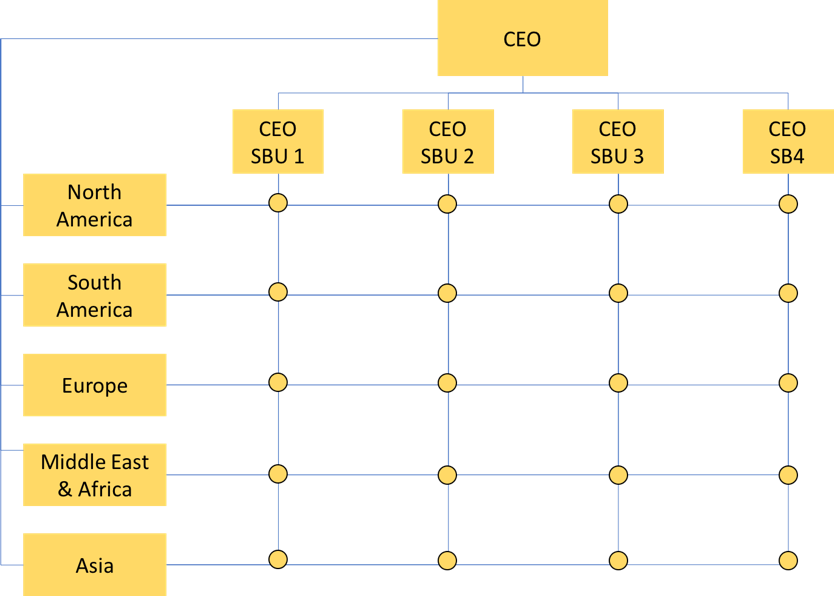
Matrix structure with geographic and product (SBU) construction.
A matrix construction creates dual lines of authority and combines functional and product departmentalization.
Advert agencies, hospitals, universities and management consulting firms use the matrix organizational construction. It's like shooting fish in a barrel to run across why – past creating a dual reporting situation, a manager who's working with a visitor on advertisement would exist able to manage a squad that included a representative from each of the needed areas to get a entrada running—a graphic designer, a space planner so on.
This structure allows for the efficient allocation of specialists. Data is more easily exchanged, as the contact between the dissimilar departments is increased.
The major disadvantage is the ability to get all these people moving at the aforementioned time, with clear priorities, to deliver a solution that's on time and on budget. It tin can also create ability struggles, because it tosses aside the idea of unity of command.
The matrix structure is amongst those that are considered "post-bureaucratic," in that it does dissimilarity in some ways with Weber's ideals. That said, the matrix construction doesn't really depart from Weber's in that hierarchy and authority even so exist here.
Practice Question
Organizational structures go on to evolve to meet the globalization and economical demands of today'southward business concern globe. Permit'south accept a look at some more modern types of structures.
Modern Organizational Design
"Post-bureaucratic" organizational structures keep to be developed to heighten how organizations do business and remain competitive. Let'due south talk virtually some of these new options, designed to aid organizations do business in today's world.
The Team Structure
In an organizational structure based on teams, the structure breaks downwardly section barriers and decentralizes decision making to the level of the team. Team structures unremarkably crave employees to exist generalists as well as specialists.
A team construction can define a whole company. Whole Foods Marketplace boasts a team-based organizational structure, with the teams shaped around their departments inside the shop—there was a produce team, a meat team, and then on. Based on the shape of the organizational nautical chart in Effigy i, you lot can sympathize why Whole Foods refers to its mission statement equally the "Declaration of Interdependence." Indeed, each of the teams is dependent on and answers to the other members of their own team and the other teams.

Figure i. Team-Based Organizational Chart
More oft than not, when larger organizations determine to utilize teams, they do then as a role of a bureaucratic construction rather than a straight team structure. Moving from a bureaucratic to a team structure requires a slap-up deal of change, so larger organizations volition gather teams and add together a quasi-team structure into their bureaucratic org chart.
Virtual System
A virtual organization is a small, core arrangement that outsources major business functions. Think of it as "renting" departments rather than owning them.
Back in the early days of Hollywood, movies were made by big studios with big bureaucratic organizational structures and a laundry listing of celebrities. Now, when y'all sit to watch a movie, you see several different production companies' logos on the screen before the movie even starts. It might brainstorm with "Paramount." And and then y'all see "Bad Robot." And maybe ii other companies. Each i of those companies has played a part in making the picture. During the credits, y'all meet animation companies and sound editing companies. Paramount may be acting every bit the central "organization." The businesses to which Paramount sends piece of work would make up the residual of the virtual organization.

Figure 2. Virtual Organizational Nautical chart
The chart in Figure 2 illustrates a typical virtual arrangement, which includes employees that practise flex-time in a dwelling function, ones that are in satellite offices domestically and internationally, and and so a group of independent contractors, telecommuters and vendors.
Paul Newman's food product visitor, Newman's Own, runs on a virtual organizational structure. Newman'due south Ain employs only 18 people, and outsources most everything—manufacturing, procurement, aircraft and the like.
Large organizations dabbling in the virtual organizational structure usually do so to outsource manufacturing. Thousands of well-known organizations are virtual in one fashion or another. General Motors, Nike, and Cisco are just a few of them. The flexibility a virtual organization provides is difficult for organizations to resist, as information technology allows them to contract out any function they feel some other organization can do more cheaply than them.
The virtual organization is definitely on the other side of the spectrum from bureaucratic organizational construction. The bureaucratic organizational structure seeks control in multiple levels and, if there is a downfall to the virtual organizational structure, it is that there is far less control over the different parts of the business.
Boundaryless Organizational Structure
American business executive and former CEO of General Electrical, Jack Welch, coined the term "boundaryless organization" when he described his platonic Full general Electric. He wanted to eliminate vertical and horizontal boundaries within GE and break downward barriers between the company and its customers and suppliers.
When an organization removes the vertical boundaries, the hierarchy flattens. Status and rank are minimized. Functional departments create horizontal boundaries, and those boundaries tin stifle interactions between departments. Functional departments can be replaced with cross-functional teams, and activities can exist organized around process.
General Electric used tools like 360 functioning appraisals, where peers, subordinates and managers could evaluate an employee'south performance. They put together cross-hierarchical teams and employed participative determination making processes.
The boundaryless organizational structure, when fully operational, breaks downwards barriers to external partners (suppliers, customers, etc.) and barriers created by geography. Telecommuting blurs organizational boundaries as well. In fact, this structure relies heavily on technology to achieve, and and then sometimes it'due south called the T-grade structure.
Holacracy
This video explains the concept of holacracy as a method of decentralized management and organizational governance in which determination making and potency are distributed amongst self-organizing teams.
Brian Robertson of Ternary Software in Exton, Pennsylvania, developed the system of Holacracy by experimenting with more autonomous forms of organizational structure. It'south a apartment arrangement organisation, significant there are few or no levels of middle direction betwixt staff and executives. The objective behind a flat organizational organisation is that employees are more involved in the determination making procedure rather than existence directly and closely supervised past many layers of management.
The essential elements of Holacracy include:
- Roles instead of chore descriptions. An private can hold multiple roles within this construct. Roles are divers by each circle—or team—via a collective governance process.
- Circle construction. Each circle is a team. Circles are organized hierarchically and each circle is assigned a clear purpose and accountabilities by its broader circle. Just the employees within that circumvolve need to determine how to all-time attain its goals. Each circle has a "lead link" and "rep link," and those people sit down in the meetings of both their circumvolve and the broader circle to ensure alignment with the organisation's mission and strategy.
- Governance process. Circles use a defined procedure to create and regularly update its own roles and policies.
- Operational process. Circles align effectually operational needs and requires that each member of the circle fulfill duties. Members have a lot of autonomy and authority and can determine on their own how to best achieve these goals.
Zappos is famously using the Holacracy model in their work, and they chose to utilize that model so they could provide first-class client service. Their theory was that they were able to put customer service decisions into the hands of the employees and eliminate brunt on upper direction.
Information technology should be noted that the term "Holacracy" is a registered trademark of HolacracyOne, LLC.
Practice Question
Which modern organizational construction best positions an organisation for success? Well, similar nosotros mentioned, organizations—particularly large ones—are committed to a bureaucratic org nautical chart, and any boosted changes in this direction are sometimes incorporated into the bureaucratic structure.
Source: https://courses.lumenlearning.com/wmopen-organizationalbehavior/chapter/organizational-structures-and-their-history/
0 Response to "What Problem Might the Ceo Expect if the Company Switches to a Virtual Network Structure"
Post a Comment